
The 54,000 Missing Stories in Illinois' Economic Boom

A few weeks ago, I came across a Crain's Chicago Business forum on Illinois' economic development milestones. The narrative was familiar: record-breaking investments, major corporate wins, and rising national rankings.
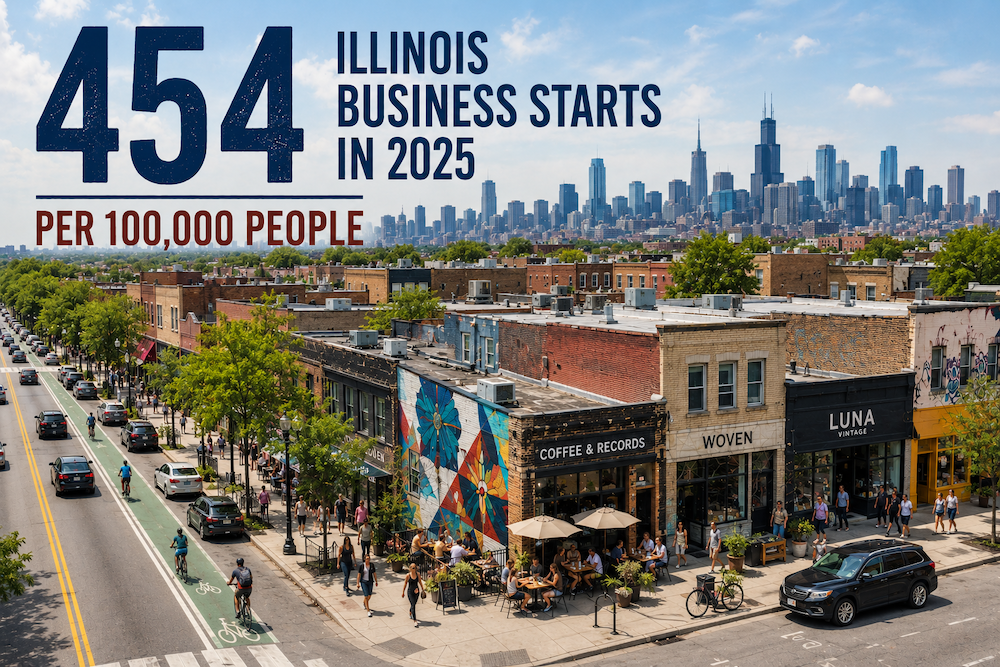
But there was one specific statistic buried in the data that stopped me in my tracks: Illinois is seeing 454 business starts per 100,000 people. On paper, it's a great stat. It looks clean. But if you stop to do the math against Illinois' population of roughly 12.5 million people, that abstract ratio turns into a staggering reality: We are talking about more than 54,000 new business starts.
And that's where the article—and much of our mainstream economic reporting—misses the mark.
When we read about "economic development," the spotlight almost exclusively lands on massive corporate relocations, billion-dollar manufacturing plants, or heavily subsidized tech hubs. But a state doesn't generate 54,000 new businesses out of corporate boardrooms alone.
The overwhelming majority of these 54,000 business starts are small businesses. They are the boutique consulting firms, the independent contractors, the neighborhood service providers, the tech founders bootstrapping in their apartments, and the local retail shops. They are the true backbone of the Illinois economy.
According to the SBA's 2025 Illinois State Profile, Illinois is home to 1.4 million small businesses — 99.6% of all businesses in the state — and they employ 43.7% of our private workforce, nearly half of every working Illinoisan. Yet, when it comes to celebrating economic triumph, they are routinely treated as an afterthought or a footnote to a macro-statistic.
Focusing solely on the "growth and stats" without investigating who or what these businesses actually are does a disservice to the ecosystem. It ignores the unique challenges small businesses face—like access to capital, navigating local bureaucracy, and scaling in a volatile market. If we don't know who they are, how can we properly support them?
And yet, even now, we are seeing this media blind spot play out again—this time, with tangible consequences.
Recently, Alderman Desmond Yancy, alongside the Small Business Advocacy Council (SBAC), championed the much-needed Chicago Small Business Bill of Rights. For the thousands of entrepreneurs who make up the backbone of our local economy, this legislation is a lifeline. It represents a fundamental push to cut red tape, provide clearer regulatory guidance, and protect the local shops that keep Chicago running from being nickel-and-dimed by bureaucracy. Among its seven articles, some of the most critical protections include prohibiting excessive daily fines that can quickly put a small business under, requiring adequate notice before fee increases are enacted, and mandating timely and consistent inspections so owners aren't losing time and money to bureaucratic delays.
But if you rely on mainstream business reporting, you likely haven't heard a whisper about it.
There is a glaring disconnect in how we talk about economic development in this city. We love to parade the metrics of small business growth, but we actively ignore the mechanics of their survival. It is incredibly telling that the media will rush to publish the "54,000" stat to prove the economy is thriving, but major outlets go quiet when it's time to cover a Bill of Rights designed to keep those very same 54,000 businesses from closing their doors six months later.
Growth stats are worth celebrating, but it's time to stop letting the aggregate obscure the individual. The real economic story in Illinois isn't just the aggregate data; it is the daily, lived reality of the small business owner.
If we want those 54,000 new business starts to actually succeed, we need an ecosystem that supports them—and a media that holds our leaders accountable to them.
Alderman Yancy's Small Business Bill of Rights is a massive step in the right direction. If you're a Chicago small business owner, the SBAC makes it easy to contact your alderperson directly and show your support — one click, right here. It's time we start giving this legislation the headline space it deserves.
At Calluna Collective, we are a small business too — and advocacy for the ecosystem that supports us all is part of how we show up for this community.