

Beyond the Link-in-Bio: How to Turn Linktree into a Tool (Not a Trap) for Your Business

If you have ever tried to grow a small business on Instagram, TikTok, or LinkedIn, you know the limitation of the "single link" rule. Social media profiles only provide one slot to direct followers to the rest of your online presence.
To solve this, many business owners use Linktree to consolidate their various profiles, promotions, and resources into one space. When you are first starting your venture, a link-in-bio tool is an easy, free way to handle this. But as your business grows from a start-up into an established brand, your tools need to evolve too. Relying on a third-party link as your primary digital home for too long can limit your growth — it is a lot like continuing to pitch a tent in someone else's backyard when you finally have the means to build your own home.
Understanding both its strengths and its limits — and how to use it strategically alongside a dedicated website — is what will keep your business moving forward.
The Function of Linktree: Strengths and Limitations
Linktree functions as a digital directory — a straightforward landing page holding a list of buttons that point people to different corners of the internet. It operates very similarly to the main navigation menu on a standard website. For a new business, this simplicity is highly practical: it requires no initial technical skills, keeps overhead at zero, and instantly centralizes your online touchpoints.
However, as your business grows, this setup can introduce real challenges:
• The Visual Trust Gap: When a potential customer leaves your social media business page and lands on a generic template, it creates a visual disconnect. The page prominently displays Linktree's branding and logo instead of your own, which can make a growing business look less established. This matters because research from Stanford University shows that 75% of consumers judge a business's credibility based entirely on its web presence.
• Overwhelming Choices: While a website menu guides visitors through a structured experience, a long list of identical text buttons can cause choice overload. When faced with too many options that look exactly the same, visitors often get confused, give up, and leave the page without taking action.
• Hidden Costs and Fees: While the Free or Starter Plan handles the basics, unlocking features like custom brand colors, email collection, or removing the platform's logo requires a paid monthly plan. The money spent on these subscriptions would often yield a better return if applied toward your own domain name or hosting. Furthermore, using their native features to sell a digital product or book a service can incur transaction fees as high as 12% — on top of standard credit card processing fees. At that point, the financial advantage of a free tool disappears entirely.
Taken together, these limitations point to the same conclusion: at some point, Linktree stops being a launchpad and starts being a ceiling.
Why a Website is the Better Choice
A dedicated website domain (such as yourbusiness.com) provides long-term advantages that a third-party platform simply cannot replicate.
Building Your Google Visibility
Search engines rank web pages based heavily on traffic and user activity. Every click from your social media page is valuable. Routing traffic through a third-party middleman means giving your search data and traffic signals to Linktree instead of using them to build your own visibility.
Understanding Your Customers
To make informed decisions with your time and marketing budget, you need to know what your audience cares about. A website allows you to securely monitor which pages are popular and where visitors lose interest, providing the insights necessary for running efficient, budget-friendly marketing campaigns. External link tools simply don't offer this level of visibility.
Using Linktree Alongside Your Website
Moving to a website does not mean shutting down your Linktree account. Used together, the two tools can actually strengthen your online presence.
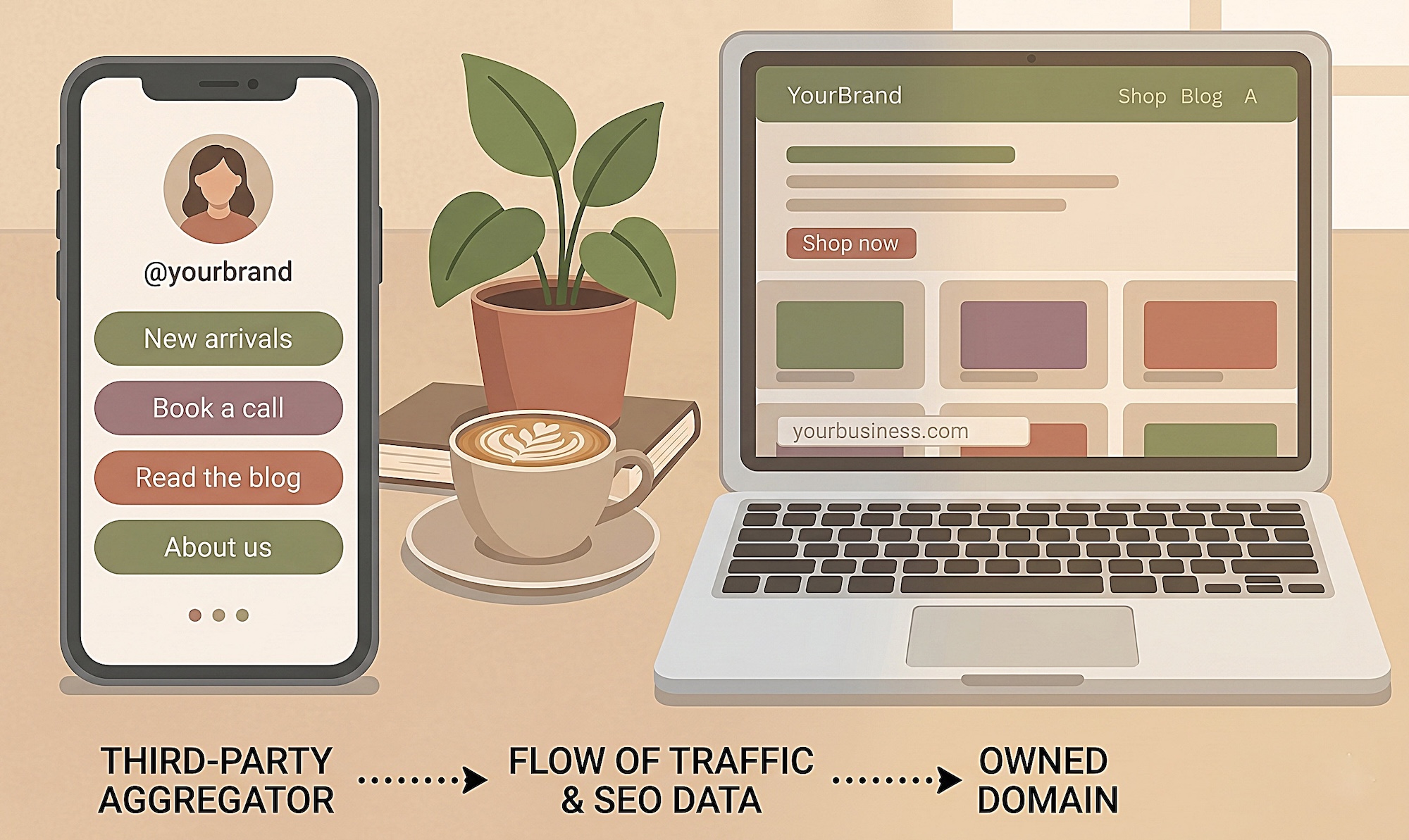
Think of it this way: your website is your permanent home, and Linktree is the front porch — a convenient stopping point with quick, direct links to timely updates like event registrations, volunteer sign-ups, or active applications. Rather than scattering users across separate third-party platforms, you use Linktree to route them straight to targeted pages on your own domain:
• Drive Traffic to Your Shop: Link directly to a specific product launch or service collection page on your website.
• Simplify Bookings: Route users straight to a consultation calendar or contact form embedded natively on your site.
• Share Content: Point readers directly to an educational article or resource published on your blog.
This approach transforms Linktree from a middleman that absorbs your traffic into a highway sign directing customers exactly where they belong: your digital storefront.
Establishing a Practical Digital Home Base
Expanding your online presence is a natural milestone for any growing small business — and it does not require a massive, months-long project to get there.
A practical starting point is a simple website with a clear menu and two or three essential pages. This keeps the clean, mobile-friendly experience that social media users expect, while giving you full ownership of your traffic, data, and brand. Modern platforms like Shopify for e-commerce, Wix or Squarespace for visual design, or WordPress and Webflow for scalability make efficient setups accessible on a small business budget.
You have already done the work of building an audience. Now it is time to build a home that belongs entirely to your brand. If you are ready to take that next step, contact us to explore the best options for your business goals.