

Domain vs. Hosting: What’s the Difference? (And How to Scale Your Site)

Setting up a website usually comes with an overwhelming wall of tech terms: Domain registry. DNS propagation. Cloud hosting. Bandwidth. It can easily feel like a foreign language—and that's not even getting to the code. But cutting through the confusion is easier if you start with the two most foundational pieces of the puzzle: your domain and your web host.
To understand the difference between the two—and why you get billed separately for
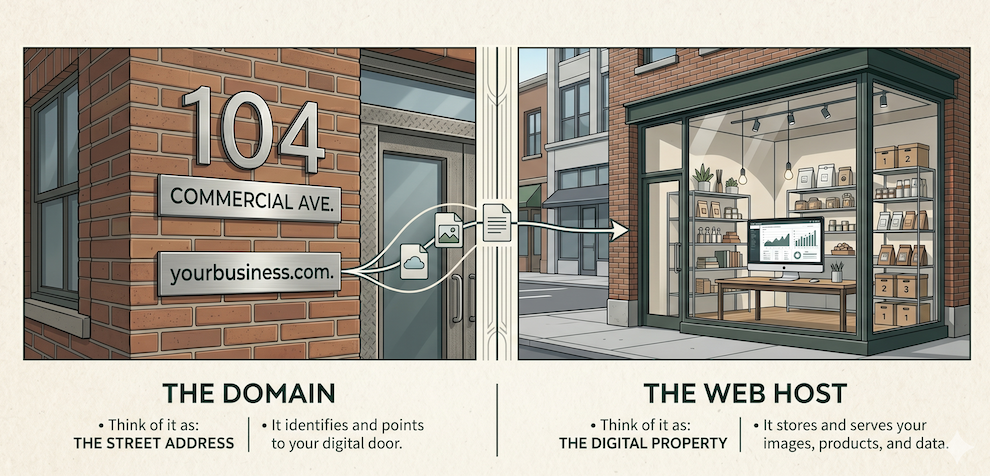
them—think of the internet as a massive city. To open a shop, you need an address so people can find you, and a physical building for your business.
The Digital Real Estate Analogy
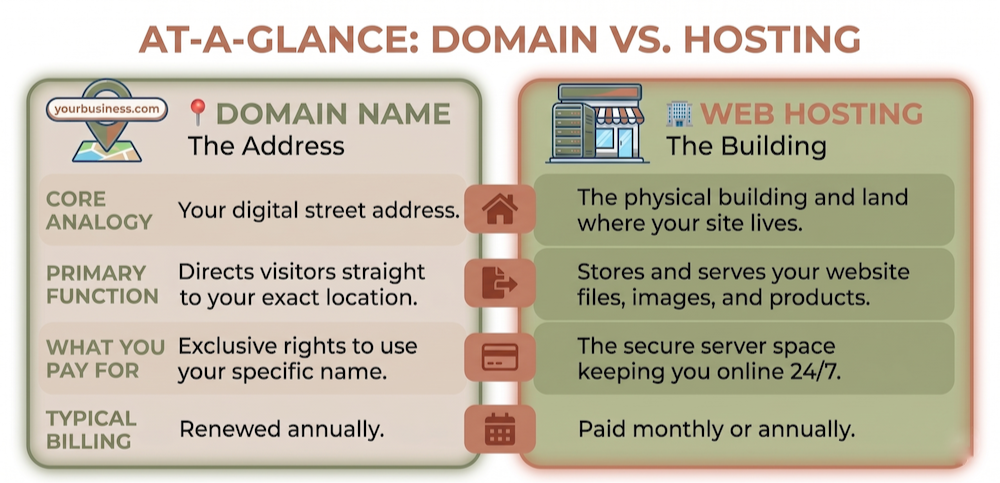
• The Domain is your street address. It’s what people type into their browser to find you. Instead of 123 Main Street, your digital address is yourbusiness.com.
• The Web Host is your building. It is the physical space where all your website's files—your photos, text, and products—live.
If you buy a great plot of land (hosting) but don't get an address for it, no one can find you. Flip that around: if you register a great address (domain) but never build anything on the property, visitors just see an empty lot. You need both to open your doors.
1. What is a Domain Name? (The Address)
Behind the scenes, computers don't read words like "Google" or your business name.
They talk to each other using long, messy strings of numbers called IP addresses
(like 192.168.1.1).
Since no one wants to memorize a string of numbers just to visit a website, domain names act as easy-to-remember shortcuts. Your domain simply translates that clunky number into a clean name.
2. Web Hosting & Business Scaling (The House)
While the domain is your address, web hosting is the building where your website lives. Buying hosting means you are renting space on a secure computer (a server) that stays powered on and connected to the internet all the time. Think of it as renting a storefront. When a customer types your address into their browser, the internet routes them straight to your door and shows them your website pages.
Different business sizes require different types of "digital buildings." Here is how hosting scales based on your needs:
Shared Hosting (The Apartment)
• The Analogy: You rent an apartment in a large complex, sharing resources like hallways, water, and internet with your neighbors.
• Best For: Small local businesses, blogs, and service providers.
• Why it fits: If your website exists to display hours, services, and a contact form, you don’t need to worry about massive, simultaneous traffic surges. Shared hosting is cost-effective and low-maintenance because the provider handles all building upkeep (server maintenance).
VPS & Cloud Hosting (The Townhouse or Condo)
• The Analogy: You share a larger structure but have your own dedicated walls, private entrance, and guaranteed resources your neighbors cannot touch.
• Best For: Growing e-commerce stores and mid-sized businesses.
• Why it fits: If an online boutique gets a sudden rush of shoppers during a holiday sale, they cannot afford a slow website because a neighboring site is hogging resources. VPS and Cloud hosting provide dedicated space to handle traffic spikes smoothly.
Enterprise Infrastructure (The Global Fortress Network)
• The Analogy: A massive, custom-built corporate campus spread across multiple continents.
• Best For: Tech giants and global corporations like Amazon or Netflix.
• Why it fits: At this scale, companies don’t just rent space—they build global ecosystems. With millions of people clicking "Buy Now" or streaming video every second, even one minute of downtime means massive revenue losses. Their setup requires absolute redundancy, elite security, and maximum computing power.
Do They Have to Be Purchased Together?
No. You can register your domain with one company and secure your hosting through another. To make them work together, you simply update a setting in your domain account (called the Nameservers) to point your address toward your hosting building. Many organizations choose to keep them separate for added flexibility, while others prefer the convenience of bundling them under one dashboard.
The Bottom Line
Digital infrastructure can feel overwhelming, but it follows very logical, real-world principles. Your domain gets your clients to the front door, and your hosting provides the comfortable space for them to interact with your business. Understanding this foundation ensures you can make confident, scalable decisions for your organization’s digital future.