

Chicago's Small Business Blind Spot: Named, Counted, and Still Not Heard


Recently Crain’s Chicago Business published a forum piece examining the city’s relentless fiscal troubles. The headline: “Chicago keeps tinkering its way to a balanced budget with new taxes, fees and fines.” The opening paragraph acknowledged something important:
“Chicago depends on a broad tax base to meet its budget needs. As the need grows, individuals and the city’s small and medium-sized businesses pay more. Close to 100,000 businesses operate in Chicago — from liquor and grocery stores to vintage and vape shops, bars and restaurants, boutiques and more. They play a role in the city budget’s math, contributing revenue by collecting and remitting sales taxes, paying localized property taxes and licensing and permit fees.”
Read that again. One hundred thousand businesses. Named, counted, and categorized — liquor stores next to boutiques next to restaurants — and then, in the very next breath, folded into a single line of budget math.
That is the blind spot I keep coming back to. Not just in Crain’s, but across mainstream economic reporting on Chicago. The businesses get acknowledged. The owners behind them disappear.
I’m someone who works with small businesses on their digital presence — and a small business owner myself. In conversations with fellow entrepreneurs and peers across Chicago, the disconnect between what the economic data claims and what owners are actually living on the ground comes up constantly. It’s why I wrote recently about what I called the 54,000 missing stories in Illinois’ economic boom — the lived realities of small business owners that vanish entirely when media coverage fixates on sweeping aggregate data. The Crain’s piece, despite its good intentions, is a near-perfect illustration of exactly that problem. Because buried beneath the pension math and policy analysis, the article inadvertently surfaces a handful of neighborhood business owner voices — and what they’re describing is nothing like the picture being painted at the top of the piece.
A few paragraphs in, the same article that opened by tallying businesses as a revenue source quotes academic financial experts confidently declaring that Chicago’s economy is “imminently capable” of generating what it needs to cover its $36 billion pension deficit — and that “residents and businesses won’t be squeezed.”
The owners those experts are speaking for tell a different story entirely.
The Voices Crain’s Buried in Its Own Story
Buried inside the Crain’s forum piece — beneath the policy analysis and pension math — are the stories of actual neighborhood business owners, and they deserve more than a supporting role.
Take Kyle Schrage, owner of Beard & Belly, who laid out the reality in plain English in the piece:
“Big businesses don’t care about the licensing fee. A couple hundred bucks to hang a sign. That doesn’t affect the big businesses. It affects the small businesses a lot.”
Exactly. Because when the city looks to balance its budget “around the margins,” it routinely treats the 100,000 small and medium-sized businesses that form Chicago’s tax base as a homogenous monolith — lumping a neighborhood bookstore or a local diner into the same bucket as a Fortune 500 corporation. It ignores the reality that these businesses are the backbone of Illinois’ economy, employing 44.7% of the total workforce and powering vibrant, immigrant-led commercial corridors like Little Village’s 26th Street, the second highest-grossing commercial street in the entire city.
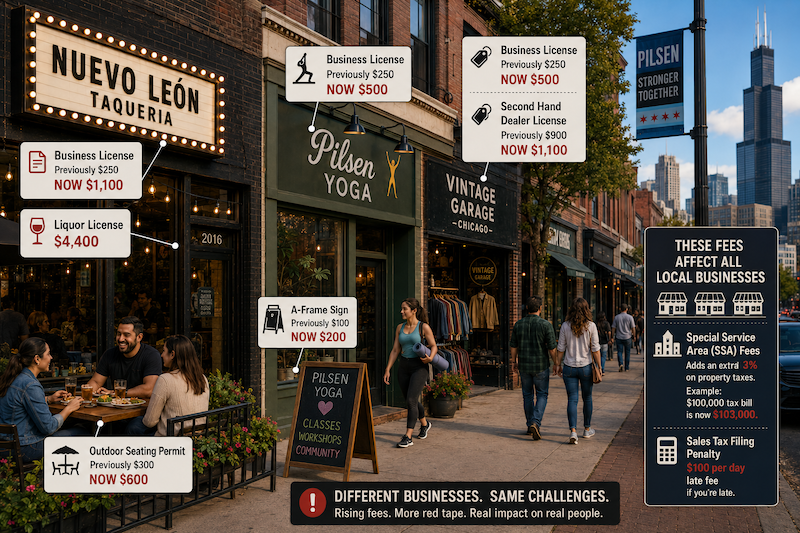
Also featured in the Crain’s piece are Duane Cerny and Jeffrey Nelson, co-owners of the Broadway Antique Market on the North Side — and the picture they paint is one of death by a thousand cuts. A signage permit fee just for having a marquee hang over the sidewalk. A Secondhand Dealer license fee quietly increased by 22% this year, jumping from $900 to $1,100. A $100-a-day penalty if they are even a day late remitting monthly sales tax receipts. A Special Service Area tax that tacks on an extra 3% on property taxes.
Each of these costs lands differently depending on who’s absorbing them — and that’s the part the aggregate economic analysis consistently fails to account for. Small businesses don’t have corporate purchasing power, which means they already pay an average of 18% more for health insurance than larger competitors, and most can’t afford to offer healthcare or retirement benefits to their employees at all. Layer on top of that the reality that the average U.S. small business allocates nearly 20% of its annual gross income toward existing tax liabilities, and what looks like a minor fee adjustment from City Hall’s perspective becomes something else entirely at the neighborhood level: another weight added to a stack that was already close to tipping.
And these are just the stories that made it into print. They represent a fraction of what 100,000 businesses are navigating quietly, without a journalist present, without a quote in a forum piece, without anyone in a budget meeting asking what the math looks like from their side of the counter.
The Political Theater
And yet our local politicians love to play both sides.
In December 2025, Mayor Brandon Johnson stood at a podium to announce his “Cut the Tape for Small Business” initiative — a framework explicitly pitched to reduce bureaucratic barriers and cut cost burdens for neighborhood entrepreneurs. It made a great headline.
Weeks later, those same businesses received a very different kind of communication from City Hall.
When the final budget bill emerged, proposed corporate head taxes that would have drawn revenue from businesses with hundreds of employees — companies with the balance sheets, legal teams, and purchasing power to absorb a new cost — were stripped from the final bill entirely. The revenue had to come from somewhere. So lawmakers turned to the businesses least able to fight back: the ones without lobbyists in Springfield, without corporate counsel reviewing their tax exposure, without a billion dollars in cash reserves to cushion the blow. Instead, they voted to dramatically hike basic business license fees — some by as much as 400%. A Limited Business License doubled from $250 to $500. A Regulated Business License quadrupled from $250 to $1,000. The higher fees took effect January 1st — just weeks after the “Cut the Tape” press release went out.
This is not a coincidence of fiscal math. It is a political choice, made in plain sight, that reveals exactly whose interests get protected when the room gets quiet and the hard decisions get made. Concentrated wealth had lobbyists in that room. Neighborhood entrepreneurs did not.
The city’s defense is that fees for these licenses hadn’t changed since 2012, and that Chicago’s rates were still below peer cities like New York, where a comparable license runs $1,440. But this argument collapses under basic scrutiny. If fees were frozen for 13 years while small businesses survived a pandemic, historic inflation, supply chain collapse, and soaring labor and healthcare costs — and the catch-up bill now arrives as a sudden 400% jump, buried in a budget process that Small Business Advocacy Council President Elliot Richardson noted was specifically designed to limit opposition and reduce scrutiny — who exactly is being protected here?
The human cost of that answer is not abstract. Earlier this year, a Hyde Park resident helped a friend — an immigrant who feared retaliation and asked to remain anonymous — navigate the months-long process of applying for a cleaning business license. They did everything right. The application was approved. Then they were told the fee was $1,000. The city’s own website had still listed it at $250 as recently as January 12th. They paid the higher fee in shock. The resident later fundraised to help cover the cost.
That is what a 400% fee hike looks like when it lands on a real person.
The Structural Absurdity
This brings us to the deeper problem baked into the Chicago Municipal Code itself. Melissa Quintana, Executive Director of the Hermosa Belmont Cragin Chamber of Commerce, recently put it plainly:
“Under the Chicago Municipal Code, your license fee is based on your activity, not your income. Because of this ‘one-size-fits-all’ model, a neighborhood clothing boutique pays the exact same $500 ‘permission to exist’ as the Apple Store on Michigan Avenue. There is no sliding scale, meaning a billion-dollar corporation and a local startup are treated as equals on paper. This creates a massive burden for our entrepreneurs, where a simple license fee represents a major chunk of their monthly overhead.”
Let that sink in. To Apple, a $1,000 regulated license fee is the equivalent of selling a single iPhone — a rounding error on a balance sheet measured in the trillions. To a first-generation business owner trying to make rent, cover a utility bill, or buy raw inventory, that same fee is a barrier that can determine whether a business opens at all.
Mayor Brandon Johnson recently asked reporters: “Why are we not challenging big corporations and the ultra-rich to pay their fair share in taxes?” It is a striking question from an administration that just answered it — by stripping the corporate head tax from the budget and replacing it with a 400% fee increase on the businesses least equipped to absorb it.
What the Experts Got Wrong
Which brings us back to where we started — and to that confident declaration in Crain’s that Chicago’s economy is “imminently capable” of generating the revenue it needs, and that “residents and businesses won’t be squeezed.”
Tell that to Kyle Schrage, paying a permit fee just to hang a sign outside his shop. Tell that to Duane Cerny and Jeffrey Nelson, absorbing a 22% license hike while facing a $100-a-day penalty for a late tax remittance. Tell that to the immigrant business owner who spent months preparing an application, got approved, and was handed a bill four times larger than the one she had planned for — on the basis of a fee change the city’s own website hadn’t even bothered to update.
These aren’t edge cases. They are three stories out of 100,000 businesses, and the only reason we know them at all is because a reporter happened to ask, or a resident happened to speak up. The rest of those stories — the ones I wrote about recently, the ones that never make it into a forum piece or a budget hearing — are still out there, being absorbed in silence by the people who keep Chicago’s neighborhoods functioning.
The squeeze is not a future risk buried in pension math. It is already here, already being absorbed, and already being treated as an acceptable cost of doing business — by the very institutions whose job it is to notice.
What Needs to Change
We cannot keep asking the small businesses that anchor our neighborhoods to bail out the city’s historical debts while simultaneously shielding the corporations and ultra-wealthy who have the greatest capacity to contribute. There is a particular frustration worth naming here: the $36 billion pension deficit driving these fees and tax hikes is the product of decades of fiscal decisions made by our elected officials — decisions that small business owners had no seat at the table for, no lobbyist to represent them in, and no meaningful voice to shape. And yet they are the ones now being handed the bill. The same small business owners who cannot afford to offer their employees — or themselves — basic healthcare coverage or a 401(k) are being asked to fund retirement security for others through a tax structure that was designed without them in mind and continues to exclude them when it matters most.
The fix is straightforward in concept: a revenue-based, sliding-scale licensing system where the Apple Store and the neighborhood boutique are no longer treated as financial equals on paper. One where “cutting the tape” is a governing commitment, not a press release. And one where the next time an economist declares that businesses won’t be squeezed, someone in the room has actually talked to a small business owner first.
Until that changes, the 100,000 businesses Crain’s counted in its opening paragraph will keep being tallied as a revenue source — and the people running them will keep being missing from the conversation.